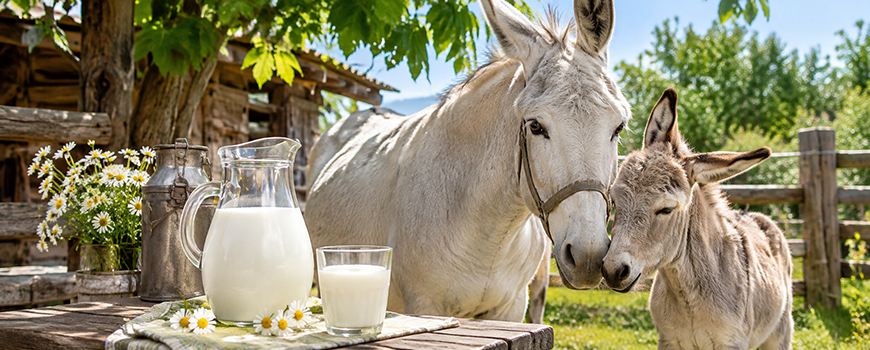
Donkey milk is one of those natural foods with a history that stretches far back in time. Known since ancient civilisations, it has been valued for its nutritional qualities and traditionally used to support the body in various conditions. Particularly interesting is its connection with folk practices for soothing coughs - a tradition that has been preserved in different parts of Europe, including Bulgaria.
Today, donkey milk is once again attracting the attention of researchers and consumers. This is due to its distinctive nutritional composition, its content of certain biologically active proteins and its potential beneficial properties.
Donkey Milk in Ancient Times - From Food to Traditional Remedy:
The history of donkey milk is closely linked to the development of ancient civilisations. It was known in Ancient Egypt, Greece and Rome, where it was used both as food and in various traditional practices aimed at maintaining health and beauty.
The ancient Greek historian Herodotus mentioned donkey milk as a nutritious drink. Hippocrates, regarded as one of the founders of medicine, also described it in his writings and recommended it for various ailments, including digestive problems, inflammatory conditions and general weakness.
Later, the Roman author Pliny the Elder devoted particular attention to donkey milk in his work Naturalis Historia. He described numerous uses that were characteristic of the medical and cosmetic practices of Ancient Rome.
Donkey milk was also valued for its use in skincare. According to historical accounts, Roman noblewomen used it in their beauty rituals, while the name of the Egyptian queen Cleopatra is often associated with legends about bathing in donkey milk.
During the 19th century, interest in donkey milk was revived in Europe. In France, it began to be used for infant feeding, particularly when breastfeeding was not possible or when other types of milk were not well tolerated.
Over the centuries, donkey milk gradually established itself as a valuable food, finding a place in both traditional diets and various folk practices.
Donkey Milk in Bulgarian Folk Medicine:
Donkey milk also has its place in traditional Bulgarian folk medicine. It was known to our ancestors as a valuable natural food, used mainly for children and people with weakened constitutions.
Particularly interesting is the folk practice of giving donkey milk to children and adults suffering from persistent coughs and whooping cough. In some parts of the Balkans, including among Bulgarian communities, it was believed that donkey milk could help the body recover more easily and soothe irritation in the respiratory tract.
This traditional use was passed down from generation to generation and became part of the rich heritage of home remedies. Although there is no precise historical date marking the beginning of this practice in Bulgaria, ethnographic accounts confirm that donkey milk was used for sick children, including those suffering from coughs.
How Is Donkey Milk Produced and Why Is It So Expensive?
Producing donkey milk is considerably more labour-intensive than producing cow's or goat's milk. One reason is the particular structure of the donkey's mammary gland, which has a relatively limited capacity for storing milk. As a result, milking needs to be carried out more frequently and under suitable conditions.
The process is usually organised around the natural feeding routine of the young donkey. Before milking, the young animal is separated from its mother for a certain period to stimulate milk let-down. Milking can then be carried out by hand or with suitable milking equipment. Some farms practise several milking sessions throughout the day, taking particular care to ensure the comfort and nutritional needs of both the mother and her young are met.
How Much Milk Does One Donkey Produce?
Unlike cows and goats, donkeys produce relatively small quantities of milk. The average daily yield is often around 1-2 litres, although it can vary considerably depending on the breed, feeding, age, stage of lactation and farming conditions. Scientific publications report yields ranging from approximately 0.2 to 6 litres per day under different conditions and for different animals.
The lactation period usually lasts around six months, with milk production gradually declining over time. In addition, some of the milk produced must be reserved for the young donkey. This means that the actual quantity available for collection and sale is even more limited.
Why Is Donkey Milk So Expensive?
The high price of donkey milk is mainly due to its limited yield and the specific conditions required for its production. The main reasons include:
- Low milk yield - one donkey produces considerably less milk than a dairy cow.
- More labour-intensive milking - milking needs to be carried out more frequently and carefully coordinated with the natural feeding routine of the young donkey.
- Limited production period - milk is produced only during a specific period following the birth of the young animal.
- More manual labour and specialised conditions - animal care, feeding, milking and maintaining good hygiene all require particular attention.
- Smaller-scale farms - donkey milk is produced in limited quantities and does not benefit from the large-scale production systems used in conventional dairy farming.
All these factors increase the production cost of the final product. Limited output and the labour-intensive milking process are among the main reasons why donkey milk is considerably more expensive than most other types of animal milk.
What Are the Beneficial Properties of Donkey Milk?
Interest in donkey milk is not based solely on folk traditions. Over recent decades, its composition and potential biological properties have become the subject of numerous scientific studies.
One of its distinctive features is that it contains relatively low levels of fat and protein, while being rich in lactose and certain whey proteins. It also contains vitamins, minerals and biologically active components.
Some of the most interesting include:
- Lysozyme - a natural enzyme with well-studied antibacterial activity. It plays a role in the body's natural defence mechanisms against certain bacteria.
- Lactoferrin - a protein that binds iron and is involved in the body's natural defence mechanisms. It is being studied for its potential antimicrobial and immunomodulatory properties.
- Lactalbumin and other whey proteins - these contribute to the nutritional value of the milk and form part of its distinctive protein profile.
- Vitamins and minerals - donkey milk contains various micronutrients, including calcium, phosphorus, potassium and vitamin C. Their levels may vary depending on the animals' diet and stage of lactation.
The combination of these components helps explain why donkey milk continues to attract scientific interest.
Donkey Milk for Coughs - Traditional Use and Modern Research:
One of the most common reasons people seek out donkey milk is its traditional use for coughs. In Bulgarian folk medicine, it was given to children and adults suffering from persistent coughs, throat irritation and during recovery from respiratory illnesses.
Why did donkey milk become so popular for this purpose?
One possible explanation lies in its composition. It contains lysozyme and lactoferrin - biologically active proteins that are part of the body's natural defence mechanisms and have demonstrated antimicrobial activity under laboratory conditions.
Lysozyme is a particularly interesting component. This enzyme is also found in human bodily secretions, including saliva and tears. One of its main functions is to help protect against certain bacteria by acting on their cell walls.
Lactoferrin also plays an important biological role. It is being studied for its ability to limit the availability of iron to certain microorganisms - an element they need to grow. Its involvement in the regulation of immune and inflammatory processes is also being investigated.
These properties explain why scientists are interested in the potential of donkey milk to support the body's natural defence mechanisms.
Other Potential Benefits of Donkey Milk:
In addition to its traditional use for coughs, donkey milk is also being studied in several other areas:
1. Supporting the body's natural defence mechanisms
Lysozyme, lactoferrin and immunoglobulins are among the biologically active components attracting scientific interest. They are involved in various aspects of the body's natural defence mechanisms.
2. Antioxidant potential
Some laboratory studies have demonstrated antioxidant activity in donkey milk and its components. This is of interest in relation to protecting cells against oxidative stress, although further studies in humans are needed to establish the practical significance of these findings.
3. Protein composition and digestibility
Donkey milk has a protein composition that resembles human milk in certain respects. It contains less casein than cow's milk and has a different whey protein profile.
Because of these characteristics, it has been investigated as a possible alternative for some children with cow's milk protein allergy. However, it is not suitable as a stand-alone replacement for breast milk or specialised infant formula. Its use in cases of food allergy should always be discussed with a doctor.
4. A food with a relatively low fat content
Compared with some other types of animal milk, donkey milk generally contains less fat and has a distinctive fatty acid profile. This makes it an interesting subject of research in the fields of functional foods and nutrition.
How Should Donkey Milk Be Consumed and in What Quantities?
Donkey milk can be consumed as a drink on its own or included in the daily diet. It is important to choose milk from a reliable producer that has undergone appropriate processing to ensure its safety.
There is no scientifically established therapeutic dose of donkey milk for coughs or other illnesses. Therefore, no universal quantity can be recommended as guaranteeing a particular health benefit.
When consumed as a food, the amount should be adjusted according to individual tolerance, age and the manufacturer's recommendations. Children, people with allergies and those with specific health conditions should consult a healthcare professional before consuming it.
Important: Consumption of unpasteurised raw milk is not recommended, as it may contain harmful microorganisms. Donkey milk can also cause allergic reactions or digestive discomfort in some people.
Donkey Milk in Modern Foods and Health Products:
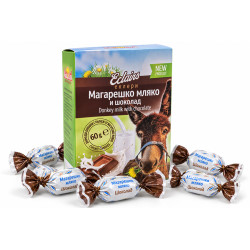
Today, donkey milk is once again finding its way into the production of various food and specialised products. Thanks to its distinctive composition, it is used to make milk-based drinks, fermented products, ice cream and milk powder.
Products in which the milk is processed into powder are of particular interest. This form makes storage and transportation easier and allows it to be incorporated into various food formulations.
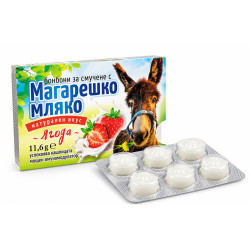
The market also offers specialised products and food supplements containing donkey milk or its derivatives. Some are marketed based on the traditional use of donkey milk for coughs and throat discomfort, as well as the interest in its biologically active components.