

Salt is one of those small ingredients that is part of almost everyone's daily life. We add it to soups, salads, meat, vegetables and home-cooked meals, often without even thinking about what it actually contains.
But there is an important difference between regular table salt and potassium salt - in potassium salt, part of the sodium chloride is replaced with potassium chloride.
This seemingly small change has an interesting role in nutrition. It allows us to reduce the amount of sodium we get from added salt while increasing our potassium intake at the same time.
This is why potassium-containing salts are attracting increasing attention from people who monitor their blood pressure, care about their cardiovascular health or lead an active lifestyle.
What Is Potassium Salt?
To understand the difference, let's start with the basics.
Regular table salt consists mainly of sodium chloride. In potassium salt, part of the sodium chloride is replaced with potassium chloride.
This is important because sodium and potassium are different minerals with different roles in the body. Both are essential, but in modern diets, sodium intake is often higher than necessary.
Potassium salt is one practical way to change the balance between these two minerals without having to give up the habit of using salt when preparing food.
Why Does Sodium Intake Matter for Blood Pressure?
Sodium is essential for the body, but excessive sodium intake is associated with higher blood pressure. High blood pressure, in turn, is one of the major risk factors for cardiovascular disease.
Part of the reason is related to the way the body regulates fluids. When we consume more sodium, the body retains more water. In some people, this can contribute to an increase in blood volume and, consequently, blood pressure.
That is why reducing excessive sodium intake is one of the key dietary measures for supporting healthy blood pressure.
This is where potassium salt can play an interesting role - instead of simply using less salt, part of regular salt can be replaced with a product in which sodium chloride is partially replaced with potassium chloride.
Potassium Salt and High Blood Pressure - Why Is This Combination Interesting?
Potassium plays an important role in regulating blood pressure. This is why potassium and sodium are often considered together when discussing nutrition and cardiovascular health.
Rather than focusing solely on eliminating salt from the diet, a more practical approach for many people is to reduce excess sodium and ensure an adequate intake of potassium through a varied diet.
When regular salt is a major source of added sodium, replacing it with potassium salt can be part of this approach.
It is important, however, to distinguish between "supports" and "treats". Potassium salt is not a medicine and does not treat hypertension. For people with high blood pressure, it may be part of an overall healthy diet, but it does not replace prescribed treatment, medication, physical activity or other recommendations from a healthcare professional.
What Do Current Recommendations Say?
This topic is no longer simply a matter of a nutritional trend. The World Health Organization recommends reducing sodium intake as a way to lower blood pressure and reduce the risk of cardiovascular disease. In its current recommendation, WHO also identifies potassium-containing salt substitutes as an option for adults in the general population who use salt to season their food.
This does not mean that everyone should automatically replace regular salt with potassium salt. The approach should take individual health circumstances into account, especially in people with kidney problems or other conditions that can affect the body's ability to regulate potassium levels properly.
How Does Potassium Support Normal Muscle Function?
Potassium is important not only for blood pressure. It is an electrolyte that contributes to the normal function of the nervous system and muscles.
Every time our muscles contract, electrical signals are transmitted between the nervous system and muscle cells. Potassium is part of the complex mechanism that allows these signals to function normally.
That is why an adequate potassium intake is particularly important for people who are physically active and regularly exercise their muscles.
In the European Union, the authorised health claim for potassium states that potassium contributes to normal muscle function. It is also authorised to state that potassium contributes to the maintenance of normal blood pressure, provided that the applicable conditions for use of the health claim are met.
Potassium Salt for Athletes - Does It Make Sense?
For physically active people, maintaining electrolyte balance is particularly important. During exercise, the muscles work intensively, while the body continuously regulates the levels of different electrolytes.
Potassium contributes to normal muscle function and supports the normal function of the nervous system, making it an important part of the diet of active people.
However, this does not mean that potassium salt should be used as a sports supplement or as a replacement for electrolyte products.
For someone who exercises regularly, potassium salt can be a practical way to include more potassium in their everyday diet when used instead of some of the regular salt.
During prolonged or very intensive exercise, especially with heavy sweating, fluid and electrolyte needs may be different. In such situations, specialised sports electrolyte products serve a different purpose and should not automatically be replaced with potassium salt.
What Does "Zdravnitza" Potassium Salt Contain?
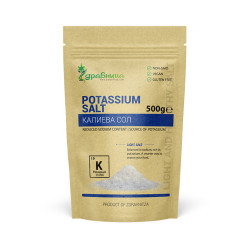
"Zdravnitza" Potassium Salt is formulated with a high proportion of potassium chloride and a reduced amount of sodium chloride.
- Potassium chloride - 66%
- Sodium chloride - 33%
- Potassium iodate - 25-55 mg/kg
This means that potassium chloride is the main mineral component of the product, while the amount of sodium chloride is significantly lower compared with regular table salt.
The formula also contains added potassium iodate. Iodine is an important micronutrient, and WHO states that the salt consumed should be iodised, with sodium reduction and salt iodisation being compatible strategies.
5 Grams a Day - What Does It Actually Mean?
This is one of the most common questions people have when they first start using potassium salt.
For "Zdravnitza" Potassium Salt, a maximum daily amount of 5 g is specified. This does not mean that you should consume 5 g of potassium salt at once, nor does it mean that you should season only one meal throughout the day.
These 5 g represent the total amount of the product for the entire day. You can distribute it between different meals according to your eating habits.
For example, you could use approximately 1 g at breakfast (about 3 pinches), approximately 2 g at lunch (about 7 pinches) and approximately 2 g at dinner (about 7 pinches). This brings the total amount for the day to 5 g.
Another option is to distribute the amount more evenly - for example, about 1.5 g (approximately 5 pinches) at lunch and 1.5 g (approximately 5 pinches) at dinner, while using the remaining 2 g with other meals or for seasoning food throughout the day.
Important: the number of pinches given here is only an approximate guide, as the size of a pinch depends on how the salt is picked up and how much salt is held between the fingers. For maximum accuracy when keeping track of the daily amount, use a kitchen scale.
There is no requirement to distribute the entire amount in any particular way. The idea is simple - you do not need to consume the potassium salt all at once. You can use it normally when preparing and seasoning different dishes, while keeping track of the total amount used throughout the day.
5 g of Potassium Salt Is Not the Same as 5 g of Regular Salt
This is another important detail.
"Zdravnitza" Potassium Salt contains a significant amount of potassium chloride and less sodium chloride. Therefore, 5 g of the product should not be understood as 5 g of sodium chloride.
At the maximum daily amount of 5 g, the product provides approximately 3.3 g of potassium chloride and 1.65 g of sodium chloride. This is one of the key differences between potassium salt and traditional table salt.
It is important to remember, however, that sodium is also found in many other foods - especially processed foods, cured meats, cheeses, ready-made sauces, savoury snacks and other foods with added salt.
Therefore, using potassium salt does not mean that the rest of your diet can be unlimited in salt.
How to Switch from Regular Salt to Potassium Salt?
There is no need to change the way you cook all at once.
For some people, potassium salt may taste slightly different from regular salt. The easiest way to get used to it is to gradually introduce it into your everyday diet.
- Start with dishes where you would normally use salt.
- Use small amounts and gradually get used to the taste.
- It is suitable for soups, salads, meat, fish and vegetables.
- You can use it both during cooking and for seasoning after the food has been prepared.
- Keep track of the total amount you use throughout the day.
Over time, potassium salt can simply become the regular salt in your kitchen.
And What Does This Mean for Heart Health?
When we talk about heart health, there is no single ingredient that can solve everything. Your overall diet, physical activity, body weight, sleep, smoking, alcohol consumption, cholesterol levels and blood pressure all matter.
That is why potassium salt should be viewed as a small change in your everyday diet, rather than as a standalone way to protect your heart.
When replacing some sodium with potassium helps reduce excessive sodium intake and contributes to maintaining normal blood pressure, it can form part of a broader approach to cardiovascular health.
Who Should Be Careful with Potassium Salt?
Potassium salt is not necessarily the right choice for everyone without first considering their individual health situation.
Particular care is needed by people with kidney disease or other conditions that may make it difficult for the body to eliminate excess potassium.
Some medicines can also increase potassium levels in the body. Therefore, if you take medication for high blood pressure or other medicines that affect potassium balance, it is advisable to discuss the use of potassium salt with your doctor or pharmacist.
Potassium salt should not be used on its own to treat high blood pressure. If you have been diagnosed with hypertension, follow the treatment prescribed by your doctor and discuss any significant changes to your diet with a healthcare professional.
Potassium Salt - A Small Change with a Practical Everyday Use:
Sometimes the easiest dietary changes are the ones we can make without completely changing the way we eat.
Potassium salt is one such example. Instead of simply removing salt from the kitchen, we can choose a product with a different mineral composition - more potassium chloride and less sodium chloride.
For people who monitor their blood pressure, this can be part of a strategy to limit excessive sodium intake. For active people, potassium contributes to normal muscle function. And for anyone who wants to make a more informed choice in the kitchen, it is an opportunity to look at everyday salt from a slightly different perspective.