- 100% MCT coconut oil
- Rich in caprylic (C8) and capric (C10) acid
- 62% caprylic acid and 37% capric acid
- Suitable for ketogenic and low-carbohydrate diets
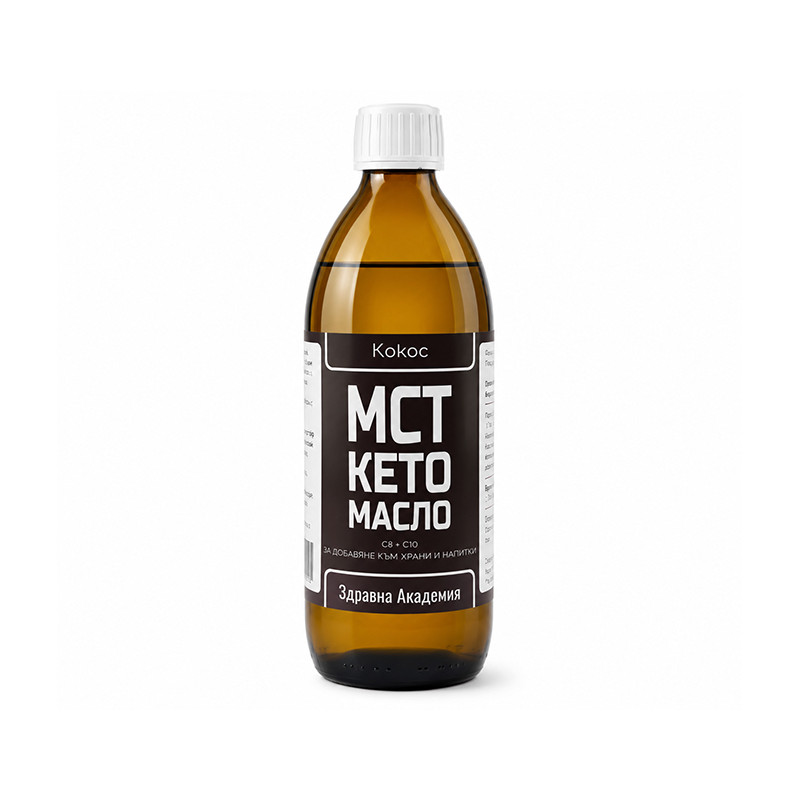
If you are looking for a way to include MCT fats in your daily diet, MCT KETO Coconut Oil by "Zdravna Akademia" provides a concentrated source of medium-chain triglycerides derived from coconut.
MCT oil differs from conventional dietary oils in the way the body processes the fatty acids it contains. Unlike long-chain fatty acids, medium-chain fatty acids are absorbed more rapidly and are transported differently, with a significant portion reaching the liver directly, where they can be used for the production of ketone bodies.
This is one of the reasons why MCT oil has become a popular component of ketogenic and low-carbohydrate diets, as well as a preferred dietary fat for people looking for a different way to include fats in their everyday meals.
What is MCT oil?
MCT stands for Medium-Chain Triglycerides. These are fats made up of fatty acids with a medium-length carbon chain.
Dietary sources of medium-chain fatty acids include coconut oil and palm kernel oil, as well as certain dairy fats. Unlike natural coconut oil, however, MCT oil is a concentrated source of specific medium-chain fatty acids.
Commercial MCT oils most commonly contain caprylic acid (C8) and capric acid (C10), as these are among the main medium-chain fatty acids used in MCT products.
MCT oil and coconut oil - what is the difference?
Although MCT oil is derived from coconut, the two oils are not the same.
Coconut oil is a natural mixture of different fatty acids, with lauric acid accounting for a significant proportion. MCT oil is concentrated in medium-chain fatty acids, and in this product the main components are C8 and C10.
This is one of the reasons why MCT oil has a specific place in dietary approaches where a higher intake of medium-chain triglycerides is desired.
The history of MCT oil and ketogenic nutrition:
Interest in medium-chain triglycerides is not new. MCT fats began to find specialised applications in nutrition as early as the 20th century, and in the 1970s the MCT version of the ketogenic diet was developed.
In 1971, a dietary approach was developed in which a significant proportion of dietary fat came from MCTs. The idea was to promote the production of ketone bodies while allowing greater flexibility in the diet compared with the classic ketogenic diet.
Since then, MCT oils have been used in various dietary approaches and have gradually become a familiar product not only in specialised diets but also in everyday nutrition.
What makes MCT oil different?
The main characteristic of MCT fats is related to the way they are absorbed and metabolised.
Medium-chain fatty acids are absorbed more rapidly than many long-chain fatty acids and reach the liver through the portal circulation. There, they can be oxidised and some of them can be converted into ketone bodies.
Ketones are water-soluble compounds that the body can use as an energy substrate. This characteristic is one of the reasons for the interest in MCT oil in ketogenic and low-carbohydrate diets.
Caprylic acid C8:
Caprylic acid, also known as octanoic acid (C8:0), is one of the characteristic fatty acids found in MCT products.
In MCT KETO Coconut Oil by "Zdravna Akademia", it accounts for 62% of the fatty acid profile. C8 is one of the fatty acids that is rapidly absorbed and metabolised and has a pronounced ketogenic potential.
Capric acid C10:
Capric acid, also known as decanoic acid (C10:0), is the second major fatty acid in the product.
It accounts for 37% of the fatty acid profile and complements the high C8 content. Together, these two fatty acids account for 99% of the stated fatty acid profile of the product.
What is the fatty acid profile of the product?
One of the key features of this product is its clearly defined C8/C10 profile:
- Caprylic acid (C8:0) - 62%
- Capric acid (C10:0) - 37%
- Caproic acid (C6:0) - 0.3%
- Lauric acid (C12:0) - 0.3%
This profile distinguishes the product from regular coconut oil and places it closer to concentrated MCT oils intended for dietary use.
MCT oil and the ketogenic diet:
MCT oil has a particular role in ketogenic nutrition because medium-chain triglycerides can stimulate the production of ketone bodies.
The ketogenic diet is characterised by a significant restriction of carbohydrates and a higher proportion of dietary fat. When carbohydrate availability is reduced, the body increases its use of fats and ketone bodies as energy substrates.
Adding MCT oil is one way to increase the intake of medium-chain fats as part of such a dietary approach.
Important: MCT oil does not by itself turn a meal or dietary pattern into a ketogenic diet. It can be part of an overall low-carbohydrate or ketogenic dietary approach.
MCT oil as a source of energy:
One of the reasons MCT fats are popular is their different metabolic pathway. After absorption, they can reach the liver relatively quickly and be used for energy or for the production of ketone bodies.
This makes them an interesting dietary fat for people following a low-carbohydrate diet, practising intermittent fasting or looking for alternative ways to include fats in their diet.
MCT oil and body weight management:
MCT oils are often associated with dietary approaches aimed at body weight management because of the different way in which medium-chain fatty acids are metabolised.
Scientific research has produced interesting findings, including evidence of small changes in body weight and body composition in certain groups and dietary settings. However, the effects depend on the amount consumed, the composition of the MCT product, the duration of use and the overall diet, and do not mean that MCT oil itself causes weight loss.
For this reason, MCT oil is best viewed as part of an overall dietary approach, rather than as a weight-loss product.
MCT oil and the brain:
Ketone bodies can be used by the brain as an energy substrate. This is one of the reasons why MCT fats are of interest in scientific research related to ketogenic diets and cognitive function.
Human studies have produced interesting but still mixed results. Some studies report changes in cognitive measures in certain groups, while others have not found a significant effect. Therefore, it would not be accurate to present MCT oil as a means of improving memory or concentration.
Ingredients:
100% MCT coconut oil.
Does not contain: sugar, salt, carbohydrates or protein.
Nutritional value per 100 g:
Energy value: 3700 kJ / 900 kcal
Fat: 100 g
of which saturates: 100 g
Caproic acid (C6:0): 0.3 g
Caprylic acid (C8:0): 62 g
Capric acid (C10:0): 37 g
Lauric acid (C12:0): 0.3 g
Carbohydrates: 0 g
of which sugars: 0 g
Protein: 0 g
Salt: 0 g
Who can include MCT oil in their diet?
MCT oil is suitable for people looking for a concentrated source of medium-chain triglycerides and wishing to include them in their everyday diet.
It is particularly popular among people following a ketogenic, low-carbohydrate or other dietary approach with a higher intake of fats, as well as among active individuals and people exploring different dietary strategies.
Important when using for the first time:
MCT oil is absorbed relatively quickly, and larger amounts, especially in people who are not accustomed to the product, may cause gastrointestinal discomfort, loose stools or diarrhoea.
For this reason, when using MCT oil for the first time, it is sensible to start with a small amount and gradually increase the intake according to individual tolerance. Scientific publications describe gradual increases in intake as a practical approach to limiting unwanted gastrointestinal reactions.
MCT KETO Coconut Oil - everyday use for different purposes:
Whether you follow a ketogenic diet, are looking for a convenient way to include MCT fats in your diet or simply want to diversify your everyday menu, MCT KETO Coconut Oil by "Zdravna Akademia" offers an easy and practical way to do so.
Its high C8 and C10 content, pure composition and coconut origin make it a product that can find a place in everything from your morning coffee and smoothie to a variety of low-carbohydrate recipes.
How to use MCT oil?
MCT KETO Coconut Oil is a versatile dietary fat that can easily be incorporated into a variety of everyday foods and drinks.
- In coffee - add a small amount to your morning coffee and stir well.
- In tea and hot drinks - suitable for drinks where you want to include an additional source of fat.
- In smoothies - add to a fruit or vegetable smoothie.
- In protein shakes - combines well with protein and low-carbohydrate drinks.
- In yoghurt - can be added to yoghurt or another suitable dairy product.
- In salad dressings - use as part of a homemade salad dressing.
- In ketogenic recipes - a convenient addition to a variety of low-carbohydrate dishes and recipes.
MCT oil in coffee - the popular "bulletproof" option:
One of the most popular ways to use MCT oil is to add it to coffee. The oil combines well with coffee and can be whisked or blended to create a more homogeneous drink.
This way of using MCT oil is particularly popular among people following a low-carbohydrate or ketogenic diet who prefer to start their day with a fat-containing drink.
MCT oil in smoothies and shakes:
Adding MCT oil to a smoothie is an easy way to incorporate the product into your everyday diet. It combines well with protein, vegetables, avocado, nut-based drinks and other ingredients used in low-carbohydrate recipes.
When using it for the first time, it is recommended to start with a small amount and gradually increase the intake according to individual tolerance.
MCT oil in salads and cold dishes:
MCT oil can also be used in cold dishes - for example, as part of a salad dressing or added to a prepared meal.
It has a relatively neutral profile, which allows it to be combined with a variety of foods without overpowering the other flavours.
Packaging: 500 ml in a dark glass bottle
Frequently Asked Questions (FAQ):
What does MCT mean?
MCT stands for Medium-Chain Triglycerides. These are fatty acids that are processed differently by the body compared with long-chain fatty acids.
What is the difference between MCT oil and coconut oil?
MCT oil is a concentrated source of specific medium-chain fatty acids. In this product, the main profile consists of C8 and C10, while regular coconut oil contains a broader range of fatty acids.
Which MCTs does this product contain?
The product contains primarily caprylic acid C8 - 62% and capric acid C10 - 37%, along with small amounts of C6 and C12.
Is MCT oil suitable for a ketogenic diet?
Yes. MCT oil is widely used as part of ketogenic diets and can be included as a source of medium-chain fats.
Can I add MCT oil to coffee?
Yes. This is one of the popular ways to use MCT oil. For a more homogeneous drink, the oil can be stirred well or blended with the coffee.
Can I use MCT oil in smoothies?
Yes. It can be added to smoothies and protein shakes, including low-carbohydrate recipes.
Can I use it in salads?
Yes. MCT oil can be used in cold dishes and as an ingredient in homemade salad dressings.
Does MCT oil have a taste?
MCT oil has a relatively neutral taste and aroma, which makes it easy to combine with coffee, drinks, smoothies and a variety of foods.
Why should I start with a small amount?
Higher amounts of MCT oil may cause gastrointestinal discomfort in people who are not accustomed to it. Gradually increasing the amount is generally used to improve individual tolerance.
Is MCT oil suitable for daily use?
MCT oil can be included in the daily diet, but the amount should be adjusted according to individual tolerance and the overall dietary pattern.